TOPlist ❤️ Can I Use
Published:
You probably know the website caniuse.com — a very useful service that tells you whether a given browser supports a particular JavaScript feature. But it answers the question "can the browser do this?", not "can my visitors do this?". And those are two different things.
That's why I decided to join them. I built Can I Use @ TOPlist — a simple application that takes a list of JavaScript features from Can I Use and adds real data about whether your visitors actually have them available. Instead of a static matrix of browsers, you get a timeline: how support for individual features changed over time, on real traffic that TOPlist measures directly on your website.
How it works
- You select your website.
- You choose a time range (30 days, a year, 5 years, or a custom interval).
- You add the JavaScript features and properties you're interested in.
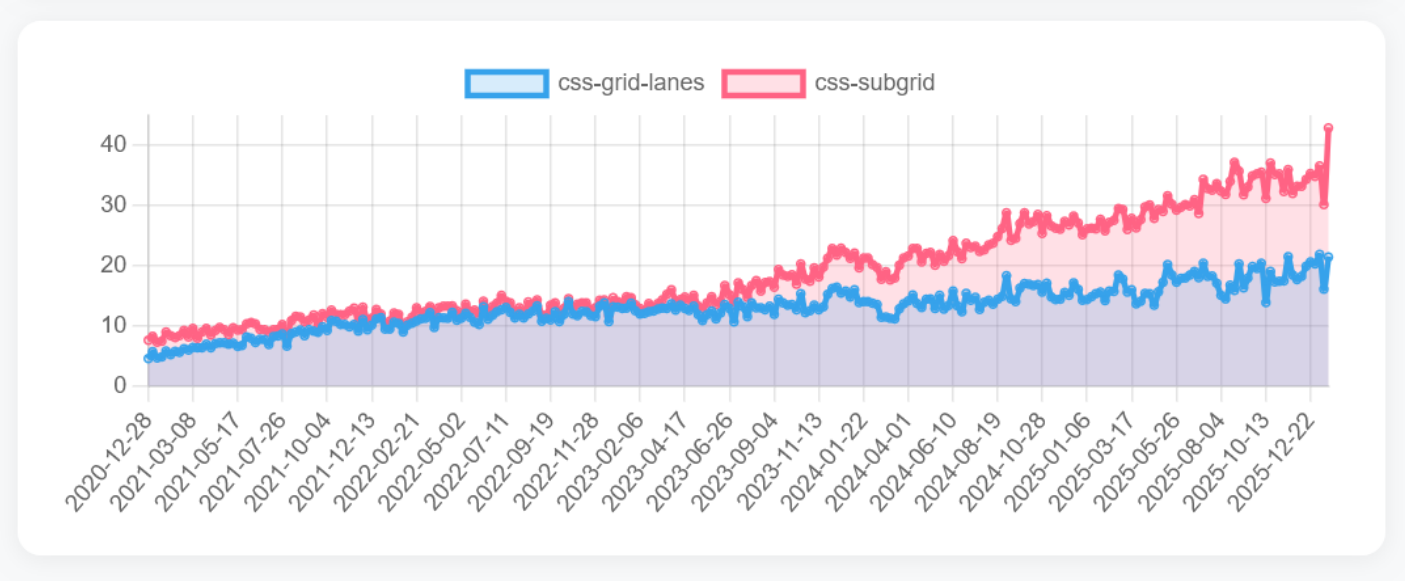
The application then draws a graph — one graph per feature — showing how many of your visitors had that feature available at any given moment. This way you can see whether the "safe" feature you want to rely on has actually taken off in your traffic, or learn its history (whether it's a feature whose support is declining or, on the contrary, will become more usable over time).
What you need
This is a personal tool, not a public service. You just need to create a serverKey in TOPlist Profi (with read_basic_stats and read_profi_stats permissions enabled) and paste it into the secrets.js file. The application is purely static — no installation, just open the page and it runs. Longer time ranges require an active subscription.
The application code is available on GitHub, or alternatively on Codeberg. It's published under the MIT license, so you can use it freely, modify it (we'll be glad if you contribute back) or use it as a reference when integrating it into your own tools.
Note: the feature list and their labels come from the Can I Use project, whose table support is licensed as CC BY 4.0. I'm not affiliated with the Can I Use project in any way — I just draw from it and mention it here.
So next time you ask "can I use this?", you'll have the answer to the other half of the question available too: "… and can my visitor use this?"